Loading...

HOW SAP S/4HANA & SAP ARIBA ADDRESS TODAY’S TOUGHEST PROCUREMENT CHALLENGES

The Procurement Challenges Keeping C-Level Executives Up at Night

Organizations face four recurring pressures: tariffs and volatile cost structures, contract leakage through maverick spend, fragile supply networks, and rising ESG accountability. These challenges are interconnected. Solving one in isolation rarely works.
The pressures above aren’t new topics. Every C-level executive in a room has heard them before.
What has changed is the speed and the margin for error.
In today’s fast-evolving digital world, leaders need an integrated procurement model that connects sourcing decisions with financial execution. SAP S/4HANA Procurement and SAP Ariba were designed to tackle the challenges mentioned above.

SAP S/4HANA and SAP Ariba aren’t simply two products sold together. SAP Ariba handles everything upstream of the purchase order sourcing, contracts, and supplier qualification. SAP S/4HANA manages execution and settlement downstream. SAP Business Network connects both sides to the global supplier base in real time.
At the heart of the platform, SAP S/4HANA delivers real-time spend transparency through embedded analytics and SAP Fiori dashboards. C-level executives gain instant visibility into total cost structures, tariff impacts, and margin risk enabling data-driven decisions rather than gut-feel responses.
Automated procure-to-pay workflows, three-way matching, and integrated compliance controls eliminate manual bottlenecks and enforce policy at every transaction.
Where SAP S/4HANA governs execution, SAP Ariba governs strategy. Competitive auctions and structured sourcing events allow procurement teams to counter inflationary pressure with market discipline.
Centralized contract lifecycle management prevents leakage, while SAP Business Network connects organizations to millions of vetted suppliers making multi-sourcing and regional diversification an operational reality, not a theoretical goal.
AI is clearly a massively complex area to understand and apply to procurement and the broader business. But given its ability to shape and disrupt supply markets and the spend management processes that tap those markets, CPOs and other business executives need to know what they don’t know and get savvy on how to understand and apply this emerging class of game-changing technology.
By embracing AI, SAP Ariba is not just making procurement smarter; it is enabling organizations to stay competitive in an increasingly complex global market.
AI analyzes historical data and market trends to forecast demand, which helps identify when to source and what opportunities to target. It also scans contracts upon upload, extracts the contents, and categorizes what it recognizes as important.
By automatically extracting key information, these solutions not only save organizations time but also allow quick access to the most relevant aspects of a particular agreement dates, parties, clauses, obligations, and more for subsequent deeper analysis. AI can also suggest clauses during negotiation and authoring processes.
AI can also be involved in casual buying. In this scenario, AI goes beyond basic rules and workflows by analyzing system data and patterns to suggest the most optimal purchasing methods, such as utilizing catalogs, e-forms, and other options.
This helps ensure that purchases adhere to company guidelines, fulfill user requirements, and align with business objectives. A guided buying experience streamlines and improves the procurement process, resulting in a more user-friendly and customized experience that also supports spend category requirements.
AI is also used to facilitate n-way matching of invoices, reducing errors and accelerating the process. This technology can extract and interpret textual and numerical data from paper or scanned invoices.
AI doesn’t rewrite your procurement process. Instead, it removes the friction that has been slowing it down at every stage. Procurement teams are spending less time managing the process and more time managing outcomes. That’s the shift.
Sourcing becomes structured and data-driven. Contract compliance moves from audit-based detection to live enforcement. Requisitions are auto-classified and routed intelligently, limiting off-catalog buying. Supplier collaboration evolves into real-time exchange of orders and invoices. For finance teams, automated matching and AI-assisted workflows reduce manual exception handling significantly.
Organizations implementing integrated SAP S/4HANA and SAP Ariba solutions report consistently strong outcomes across key performance indicators:
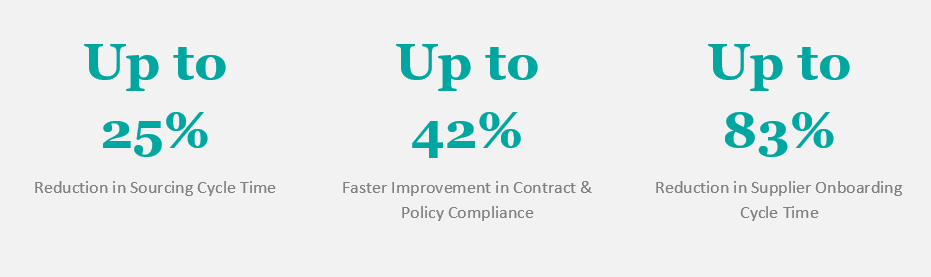
Source: SAP Learning — “Summarizing SAP Direct Spend Sourcing Benefits and Framework.”
https://learning.sap.com/courses/sap-ariba-sourcing-overview/summarizing-sap-direct-spend-sourcing-benefits-and-framework_d17c4450-0539-4751-ba2c-2cb7dfdb6c25
The C-level executives achieving the greatest impact today are not simply deploying new software. They are repositioning procurement as a strategic function. With SAP S/4HANA and SAP Ariba as the foundation, procurement leaders gain unified data, intelligent automation, and supplier collaboration capabilities to contribute meaningfully to margin protection, ESG reporting, and long-term supply resilience.
Volatility is not going away. But with the right solution, it stops being a threat to manage and becomes an opportunity to outperform competitors who are still relying on fragmented systems and reactive processes.
When procurement and finance share a single version of reality, conversations shift from explaining past results to anticipating risk and guiding business strategy. The transformation is operational as much as technological, allowing procurement to evolve from a reactive cost center into a proactive driver of resilience and growth.

HOW SAP S/4HANA & SAP ARIBA ADDRESS TODAY’S TOUGHEST PROCUREMENT CHALLENGES

HOW SAP S/4HANA & SAP ARIBA ADDRESS TODAY’S TOUGHEST PROCUREMENT CHALLENGES

HOW SAP S/4HANA & SAP ARIBA ADDRESS TODAY’S TOUGHEST PROCUREMENT CHALLENGES
HOW SAP S/4HANA & SAP ARIBA ADDRESS TODAY’S TOUGHEST PROCUREMENT CHALLENGES
HOW SAP S/4HANA & SAP ARIBA ADDRESS TODAY’S TOUGHEST PROCUREMENT CHALLENGES
HOW SAP S/4HANA & SAP ARIBA ADDRESS TODAY’S TOUGHEST PROCUREMENT CHALLENGES
Learn how we can help you achieve similar results with a customized digital transformation strategy.